


The total energy is, however, not yet conserved by the above described
Type III algorithms. In order to achieve this we introduce a further
parameter without changing the good properties
according to the Gauss' law and unitarity discussed in the previous
sections.
We can achieve this, by rescaling the complement link variable
 with a link independent but time dependent factor
 during the
numerical update procedure. It should, of course, not deviate from
the value 1 in the continous time limit
during the
numerical update procedure. It should, of course, not deviate from
the value 1 in the continous time limit 
The update equations become this way
with the Lagrange multipliers

Since is time dependent, it cannot be disantangled from an arbitrary
implicit recursion scheme analytically. This fact provides us further
restrictions on the applicability of Type III or Type IV algorithms.
Furthermore it is just consequent to use the same  parameter
in calculating the control quantity which should be the numerical
approximation to the total energy of the system. Here is also some
freedom to make a choice, we choose a formula which leads to a quite
simple updating of the parameter in the OET scheme.
It is as follows
parameter
in calculating the control quantity which should be the numerical
approximation to the total energy of the system. Here is also some
freedom to make a choice, we choose a formula which leads to a quite
simple updating of the parameter in the OET scheme.
It is as follows

because in the OET scheme all 'star' quantities
( )
are replaced by their intermediate time values
)
are replaced by their intermediate time values
 In this case it is especially
simple to derive the rate of change of the energy according
to the general definition
In this case it is especially
simple to derive the rate of change of the energy according
to the general definition
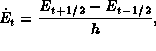
which becomes

Since the force  acting on a group element on a given link is a nonlinear
function of some neighbouring link values
it is in general not possible to resolve an other implicit recursion scheme,
which uses the updated values (
acting on a group element on a given link is a nonlinear
function of some neighbouring link values
it is in general not possible to resolve an other implicit recursion scheme,
which uses the updated values ( ) themselves for
calculating
) themselves for
calculating  .
In the OET scheme, however, we can just replace
the recursion equations ( 55 )
imediately.
After some trivial algebraic work we arrive at
.
In the OET scheme, however, we can just replace
the recursion equations ( 55 )
imediately.
After some trivial algebraic work we arrive at
In the continous time limit ( ) this tends towards
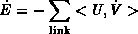
which has to be zero. In this limit all the
parameters are
equal to 1, as well.
The energy conservation in the continous time limit can be easily
derived considering, that the quantity  also can be
obtained as part of the time derivative of <U,V>:
also can be
obtained as part of the time derivative of <U,V>:
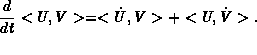
On the other hand this is equal to

if summed over all plaquettes and all links respectively.
(Without summation this equality does not hold; with other words only
the total energy is conserved, but there is a possible energy transfer
between links through their coupling via shared plaquettes.)
It completes the proof of the continous time limit energy conservation
that calculating the time derivative of the plaquette group elements
 each link group element U occurs once as a time derivative
 and three times as part of
the complement variable
and three times as part of
the complement variable  associated to the link where the time derivative is taken.
We conclude that this way
associated to the link where the time derivative is taken.
We conclude that this way

so the total sum  vanishes.
We require the same property for the numerical update procedure setting
to zero
in eq.( 59 ).
This leads to the following update prescription for the
parameter

Since the updated
is not used in the OET scheme,
- and not even in some half implicit algorithms using  but not
  for the update, because the recursion equation
for U does not depend on
(also not via
for the update, because the recursion equation
for U does not depend on
(also not via  ) -
it is now starightforward to calculate new quantities from the old ones
fulfilling all local and global constraints steming from the
unitarity and orthogonality of group elements, from the Noether charge
conservation (keeping deviations from the Gauss law constant
during the time evolution) and from the total energy conservation.
This completes the update procedure.
) -
it is now starightforward to calculate new quantities from the old ones
fulfilling all local and global constraints steming from the
unitarity and orthogonality of group elements, from the Noether charge
conservation (keeping deviations from the Gauss law constant
during the time evolution) and from the total energy conservation.
This completes the update procedure.
Finally we note that the 1-s in the numerator and denominator of the above
formula have to be replaced by the ratio of spatial and time resolution,
 , in the general case.
This modification improves the stability of the recursion, if
, in the general case.
This modification improves the stability of the recursion, if  .
.

