


An example of a motion on the unit circle under the influence of an external force is the pendulum. The Hamiltonian describing its motion is

with  , where all further parameters, like the mass, the
length of the pendulum and the gravitational acceleration constant are
absorbed into the units of energy (
, where all further parameters, like the mass, the
length of the pendulum and the gravitational acceleration constant are
absorbed into the units of energy ( ) and time (
 ).
The equations of motion
).
The equations of motion

lead to the error propagation equations

which --- since  may vary between -1 and +1 --- behaves sometimes
like the exponentional growth and therefore none of the numerical
algorithms is really safely applicable.
An increasing difference in an initially small deviation in the angle
may vary between -1 and +1 --- behaves sometimes
like the exponentional growth and therefore none of the numerical
algorithms is really safely applicable.
An increasing difference in an initially small deviation in the angle  ,
especially near to the value
,
especially near to the value  , is, however, not blown up in the
 cartesian coordinate space, since the motion --- in principle ---
takes place on the unit circle
cartesian coordinate space, since the motion --- in principle ---
takes place on the unit circle  .
Therefore a description in terms of cartesian coordinates
.
Therefore a description in terms of cartesian coordinates
 seems to be more handy for computation.
It is, however, still not sure, that a numerical algorithm
updating the variables
seems to be more handy for computation.
It is, however, still not sure, that a numerical algorithm
updating the variables  remains on the unit circle for a long
enough time using a sufficiently small time step.
remains on the unit circle for a long
enough time using a sufficiently small time step.
In order to enforce the constraint of moving on the unit circle we add a corresponding term to the Hamiltonian,

where the Lagrange multiplier,  , is calculated from the requirement,
that the motion conserves the constraint
, is calculated from the requirement,
that the motion conserves the constraint  .
.
For the sake of simplicity let us discuss in the following the free motion
on the unit circle only, i.e. without the term  in the Hamiltonian,
since this way the computation
moves also on the same energy shell as the one formulated in terms of the
angular variable
in the Hamiltonian,
since this way the computation
moves also on the same energy shell as the one formulated in terms of the
angular variable  only.
An interacting system of many such motions will
be encountered in the next chapter dealing with lattice gauge theory.
only.
An interacting system of many such motions will
be encountered in the next chapter dealing with lattice gauge theory.
The free Hamiltonian restricted to the unit circle leads to the equations of motion
The first time derivative of the unitary constraint,

can be fulfilled initially by an apropriate choice of the momentum
vector  orthogonal to the position vector
  .
In order to keep this orthogonality as well as the unitary norm of
the position vector also the second derivative,
.
In order to keep this orthogonality as well as the unitary norm of
the position vector also the second derivative,

has to vanish. This is satisfied, if we choose

Substituting it back into the equations of motion ( 28 ) we see the effect of the centripetal force keeping the moving point on the unit circle.
Now before we discuss how numerical algorithms can preserve such unitary
constraints let us introduce some simpler and more easily generalizable
notations. A letter 'P' or 'Q' stands for a vector of variables  or
or  but for any number of components.
 denotes the scalar product of two vectors,
while
denotes the scalar product of two vectors,
while

their product as complex numbers  .
This way
.
This way  denotes a complex combination of the scalar and
vector product of two vectors.
denotes a complex combination of the scalar and
vector product of two vectors.
This notation is generalizable for other unitary group elements, e.g. for quaternions representing SU(2):

where the  -s are the Pauli matrices.
In matrix notation --- usually used for SU(N) group elements ---
the product AB is then the matrix product and
-s are the Pauli matrices.
In matrix notation --- usually used for SU(N) group elements ---
the product AB is then the matrix product and

For SU(2) the square length of a quaternion vector, <A,A> =detA is normalized to unity.
Using the above notations the general Hamiltonian of the unitary free motion can be casted in the form

It leads to the (vectorial or matrix) equations of motion

The Lagrange multipliers,  and
and  , are obtained as being
containing the general centripetal force and an orthogonal projection of
the velocity. Using the unitary constraint
<Q,Q>=1 itself they further reduce to  and
and
 .
We note again that in order to maintain <Q,Q>=1 independently
of the time evolution
the orthogonality <P,Q>=0
also has to be set
initially and --- as a consequence of the correct
equations of motion --- conserved during the recursion.
.
We note again that in order to maintain <Q,Q>=1 independently
of the time evolution
the orthogonality <P,Q>=0
also has to be set
initially and --- as a consequence of the correct
equations of motion --- conserved during the recursion.
The error propagation equations taken at the <P,Q>=0, <Q,Q>=1 point,

give information about the stability of the unitarity
(N=<Q,Q>=1), the orthogonality (O=<P,Q>=0) and the energy shell
constraints (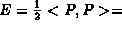 const.).
Using the respective definitions we arrive at
const.).
Using the respective definitions we arrive at

meaning marginal stabilty.
We note here, that the naive update procedure  ,
,
 would have led to the constraint stability equations

which --- although more complicated in form --- also have three zero eigenvalues.
The symmetry transformation which leaves the above Hamiltonian invariant "rotates" all vectors reserving the lengthes <Q,Q>, <P,P> and the orthogonality <Q,P>. This can be comprised into

where U has a unit length <U,U>=1.
The generator of an infinitesimal transformation --- rigid group
rotation --- is obtained in this case as  .
.
A general, Type III numerical algorithm uses the following recursion relations for the update in case of the motion discussed here
Using the general definition of the Noether charge ( 16 ) we get

The rate of its change can be expanded into the form

Substituting the recursive differences from the equations of motion ( 39 ) it reduces to
which is proportional to the unit group element --- since all expressions
like
 are.
In order to satsify the Noether theorem we would need therefore
are.
In order to satsify the Noether theorem we would need therefore
The different control quantities, like norm, orthogonality or energy, should be conserved by the update procedure. With the method of Lagrange multipliers we can, of course, ensure this with any sensible definition. It avoids a conflict with the Noether charge conservation, however, only then, if the respective numerical definition of these control quantities follows the scheme set by the Noether charge.
Let us denote in general a group product
in the continous time limit by 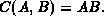 If A is of the same type as P and B as Q, i.e. we use the conventions

then the rate of change of the quantity C, defined by

can be obtained as being

which is the closest to the continous time chain rule for time derivatives. Here the quantity C was defined at half ineteger intermediate time steps similar to the Noether charge,
and we used the trivial definitions


Following this philosophy the norm of the position vector would be defined by

the orthogonality by

and the energy by

These definitions can, hoewever, work only then if  This defines Type IV algorithms. Especially b=1, a=c=0
is an entirely explicit algorithm using odd and even time
values for the recursion alternatingly (OET).
This defines Type IV algorithms. Especially b=1, a=c=0
is an entirely explicit algorithm using odd and even time
values for the recursion alternatingly (OET).
Below we list the Type IV definitions for the norm, orthogonality and energy:

The rates of changes of these quantities according to the general formula ( 46 ) and using the equations of motion ( 39 ) become

Requiring that the norm and the orthogonality --- which in this case is just the trace of the Noether charge --- are conserved, we obtain the following Lagrange multipliers:

One can easily convince himself/herself that with these values of the Lagrange multipliers the above defined energy is conserved as well. In particular the use of the OET algorithm (b=1, a=c=0) has a marginal error propagation stability, i.e. there is no magnification or reduction of errors orthogonal to the constraining surfaces.





