


Both the harmonic oscillation and the exponentional growth are described by the generic Hamiltonian
with either  (oscillator) or
  (exponential
growth). The linear stability analysis of an update algorithm considers
then the recursion formula ( 2 )
with the general definition ( 3 )
with respect to small deviations from the recursive values
up to linear order. In general one assumes that the numerical error
becomes multiplied with a complex factor z in each recursion step
by increasing the recursion depth t to t+1. An algorithm is stable
if and whenever |z| < 1, otherwise it is unstable. If this error magnifying
or reducing property of the algorithm is independent of the time step size h,
then it is called unconditionally stable or unstable[5].
(exponential
growth). The linear stability analysis of an update algorithm considers
then the recursion formula ( 2 )
with the general definition ( 3 )
with respect to small deviations from the recursive values
up to linear order. In general one assumes that the numerical error
becomes multiplied with a complex factor z in each recursion step
by increasing the recursion depth t to t+1. An algorithm is stable
if and whenever |z| < 1, otherwise it is unstable. If this error magnifying
or reducing property of the algorithm is independent of the time step size h,
then it is called unconditionally stable or unstable[5].
In the simple case of the above Hamiltonian ( 17 ) the recursion formulae ( 2 , 3 ) leads to the following error propagation equations

The general Type III algorithms lead to the following eigenvalue equation for the magnifying factor z:
Considering now the equation

from its general solution 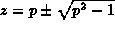 it can easily be seen that for |p| > 1 there is always one root
with |z| > 1 and for a real p with |p| < 1 there are complex roots
with |z| = 1. While in the first case the algorithm is unstable in the
second case it is marginal.
it can easily be seen that for |p| > 1 there is always one root
with |z| > 1 and for a real p with |p| < 1 there are complex roots
with |z| = 1. While in the first case the algorithm is unstable in the
second case it is marginal.
Now from the eigenvalue equation ( 19 ) we get

which using the above definition of p after some trivial algebraic manipulations can be casted into the form

Expanding the solutions for small  we get

showing that |p| > 1 for whatever small time step h if  .
(Here we remind that a+b+c=1 by definition.)
It means that for the exponential growth all algorithms are unconditionally
unstable, while for oscillatory dynamics they are all marginal.
For these simple systems there is no distinction in their computational
applicability.
.
(Here we remind that a+b+c=1 by definition.)
It means that for the exponential growth all algorithms are unconditionally
unstable, while for oscillatory dynamics they are all marginal.
For these simple systems there is no distinction in their computational
applicability.
A comment about the unconditional instability of the exponential growth
maybe proper here. Of course there cannot be any algorithm solving an
equation like  which does not lead to exponentially growing
errors, because this is already inherent in the continous time differential
equation. The natural exponential divergence of small initial
deviations
which does not lead to exponentially growing
errors, because this is already inherent in the continous time differential
equation. The natural exponential divergence of small initial
deviations  can then be followed in time as long as the
magnified numerical uncertainity outgrows the initial amplitudes
can then be followed in time as long as the
magnified numerical uncertainity outgrows the initial amplitudes
 themselves. This, however, never happens before the time dependent
amplitudes
themselves. This, however, never happens before the time dependent
amplitudes  become bigger than the maximal representable number
on the computer.
become bigger than the maximal representable number
on the computer.
This kind of instability therefore prevents us from following the dynamical evolution too long, but it does not prohibit to gain reliable information about the initial divergence of adjacent phase space points. In fact, numerical techniques, which obtain the whole Lyapunov spectrum of exponentially growing and decreasing eigenmodes of the vectors Q and P, rescale the amplitudes used to evaluate the divergence or convergence rate of small deviations in the phase space after short time periods.
On the other hand it is still important that the eventually chaotic evolution of a constrained system --- like two coupled pendulums --- is described by a numerical algorithm, which does not destabilizes the constraint. The Lyapunov exponents have to be calculated in the subspace of the phase space allowed by these constraints, for example in conservative systems on the energy shell. A minimal requirement from a numerical algorithm is therefore that it keeps the updated phase space vectors near to the energy shell (and near to any constrained surface) longer then the time, which is necessary to obtain the Lyapunov exponent.

